Tap anywhere outside image to close
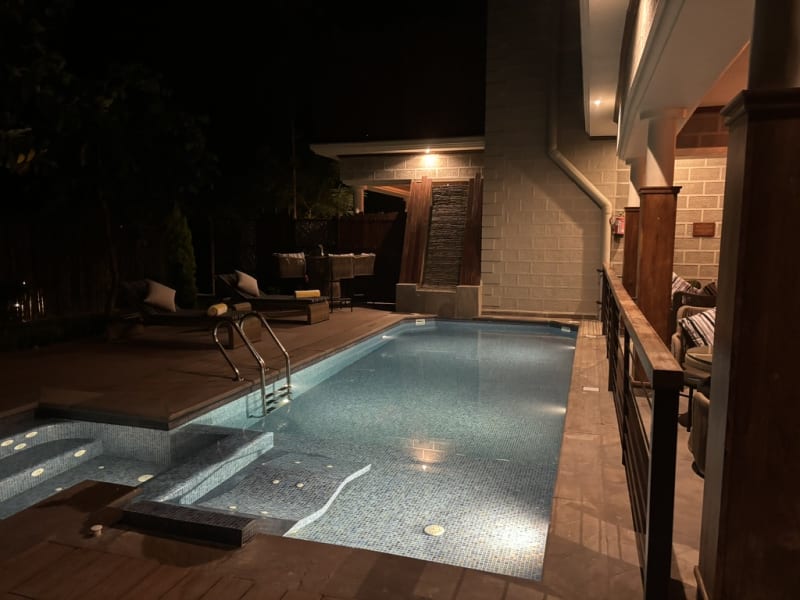
A pool built twenty years ago is usually the oldest thing on the property. Almost everything a new pool is specified to today can be built into one that exists. Heating, hydrotherapy, counter-current swimming, glass media filtration, UV or ozone, light, water features — and a pool that cleans, doses and watches itself.
Walk through a property whose pool was built twenty years ago, when owning one still placed you among a privileged few, and the pattern is almost always the same. The kitchen has been redone, probably twice. The bathrooms have been redone. The lighting, the air conditioning, the audio, the glazing — all replaced as the technology improved and the cost of it fell.
The pool is exactly as it was handed over.
That is not neglect. It is a hangover from what these things used to cost. In those years a heated pool was the equivalent of a first-class air ticket — four times the price for the same destination. Sophisticated filtration and treatment were things public aquatic centres bought, not households. So owners took what was reasonable at the time: a pool that worked for six or seven months of the year, water that looked acceptable from the deck, chlorine dosed by hand, and two lights in the wall.
Every one of those compromises was a cost decision, not an engineering one. And every one of them has since been overturned by equipment that is better, quieter and far less expensive to run than what it replaces.
A twenty-year-old pool is rarely a worn-out pool. It is usually a sound structure carrying twenty-year-old decisions.
Owners have worked this out for themselves, and it has quietly changed how pools are specified. Price the footprint a pool occupies — the water, the deck around it, the plant room, the setbacks it imposes on everything else — against what that same land is worth today, and the structure and equipment stop looking like the significant number. They are a fraction of it.
Once that is clear, the questions change. An unheated pool is comfortable for perhaps six or seven months. The land underneath it is paid for twelve. Nobody would accept a wing of a house being shut and sheeted over for five months a year, yet that is precisely what an unheated pool asks of the single most valuable part of the property.
The same reasoning runs past the calendar and into what the pool is actually used for. A rectangle of water you swim a few lengths in on a warm evening is one return on that land. The same rectangle, warm all year, carrying a spa and loungers for recovery and a counter-current for genuine exercise, is a different one entirely — without an additional square metre being bought.
So the better question is no longer what is the least this pool needs? It is why would this piece of land not carry the best?
The usable season of a pool left at ambient temperature. The rest of the year it is a maintained, filtered, insured ornament.
The same water body, the same land, the same deck — roughly double the season, for equipment that is a small fraction of the land value.
An upgrade buys performance without buying footprint — the one line in the original investment that cannot be bought again.
Every item in the middle column is now ordinary on a pool we are asked to build from scratch. The right-hand column is the honest answer on whether it can be added to a pool that is already in the ground.
| What a pool of that era usually has | What a new pool is specified to now | Retrofit |
|---|---|---|
| Ambient water — a six to seven month season | Temperature held year-round by heat pump, with a thermal cover | Yes — plant room space and power permitting |
| Swimming only — no warm water, no recovery | Hydrotherapy: attached spa, in-pool loungers, jets placed to the body | Yes — the single largest change in how a pool is used |
| A pool too short to swim properly in | Counter-current unit — unlimited distance in a fixed length | Yes — wall-mounted or built into the structure |
| Silica sand media, clarity left to whatever the filter delivers | Activated glass media, clarity specified as a number and commissioned against it | Yes — media change is the simplest of all |
| Hand-dosed chlorine, chloramine smell, variable residual | UV or ozone as secondary treatment, with a low automated chlorine residual | Yes — UV is close to fit-and-forget |
| Two wall lights, often the originals | Layered light — main LEDs, strip lighting, step markers, fibre optic effects | Yes — fibre optic only while the finish is open |
| A flat, silent sheet of water | Blades, curtains, falls and deck jets on their own circuit | Yes — each feature on a dedicated pump |
| Hand vacuuming on a daily staff rota | Robotic cleaner running its own cycle, filtering independently | Yes — needs nothing from the plant room |
| Chemistry tested by hand, dosed on judgment | Probes reading continuously, dosing automated, status on a phone | Yes — installs in the plant room dosing line |
| Single-speed pump running fixed hours | Variable-speed pump matched to the actual hydraulic duty | Yes — and usually the fastest payback on the list |
| Original drain covers and fittings | Anti-entrapment covers, dual suction, bonded metalwork, RCD protection | Yes — and not optional in our scope |
| Undersized buried pipework and a cramped plant room | Hydraulics and plant room sized together, before the shell is cast | Hardest — see what cannot be retrofitted |
Feasibility is assessed per site. Nothing in the right-hand column is promised before the pool has been surveyed.
This is the commonest thing sold to an owner who says their pool feels dated, and it is worth being plain about what it does. New tiles, new coping, new grout — and the pool performs exactly as it performed the week before. The water is no warmer. It is no clearer. It is treated the same way, lit the same way, and usable for the same six or seven months of the year.
The pool looks newer. Nothing about it is newer.
None of which means finishes do not matter. A chipped waterline or failed grout has to be put right, and on most projects the finish work happens inside the same shutdown as the engineering because the pool is empty anyway and the access will not come again for years. We do that work, and we do it properly. But it belongs in its own line of the quotation, described as what it is.
Everything on the rest of this page changes what the pool does. A finish changes what it looks like. An owner is entitled to know which of the two they are being quoted for — and to be told, before the money is spent, that retiling a pool will not make it any more useful in January than it was in December.
Each of these changes what the pool actually does. They are the ones an owner notices on the first morning afterwards, and they can be taken together or one at a time.
Owners now treat this as the one upgrade that is not optional, and the reason is the land argument above: it is the difference between a pool that earns its footprint for half the year and one that earns it for all of it. A correctly sized heat pump holds the water at a chosen temperature instead of letting the season set it.
A thermal cover is what makes it affordable to run. Roughly seven tenths of a pool’s heat leaves through the open water surface as evaporation, and a cover is the only measure that acts on that directly. Heating a pool without one is the commonest reason an owner concludes that heating is expensive.
The engineering honesty on this point matters: a heat pump is a maintenance device, not a rapid heat-up device. Its output falls as the ambient air gets colder, which is exactly when it is asked to work hardest. Sizing it by rule of thumb is how owners end up with a pool that is warm in October and unusable in January.
On an enclosed or indoor pool a second question arrives with the heat: the air above the water. Warm water in a closed hall releases hundreds of litres a day into the room, and comfort air conditioning cannot remove it.
Most older pools were built to be swum in and nothing else. Warm water, counter-pressure and targeted jets — the things that turn a pool from recreation into daily physical recovery — were simply not part of what a private pool was expected to offer. An attached spa and in-pool loungers are what close that gap, and they are added to a water body that already exists.
A full sequence — warm immersion, lumbar decompression, shoulder and neck jets, leg and calf stimulation — takes about thirty minutes and delivers something close to a professional recovery session. The difference is that it happens before the first meeting of the day, at home. Clients who have lived with one consistently describe it as the most transformative thing they added.
In-pool loungers do the same work lying down: submerged beds along one edge with air jets beneath them, for the half hour nobody wants to spend swimming. On a pool that already has heating, a spa shares the plant and the warm water is largely free.
The honest constraint is the plant room rather than the pool. A spa needs its own jet pump, blower and heating, and loungers add their own air circuit. We specify jet placement to the person who will use it rather than to a catalogue position — which is only possible if the plant room has the capacity to carry it.
This is the upgrade that matters most to anyone who treats swimming as exercise rather than as a pleasure. A home pool is usually too short for a real swim — three strokes and a turn is not training, it is interruption. A counter-current unit produces a smooth, adjustable flow to swim against, and the pool stops having a length at all. You swim continuously, for as long as you want, in the pool you already own.
The flow is set to the swimmer rather than the other way round, so the same pool serves someone training seriously and someone walking against gentle resistance for rehabilitation. On a heated pool it also removes the last argument against swimming in winter, since the session no longer depends on the water being long enough to be worth entering.
It can be added two ways: a self-contained unit hung on the wall of an existing pool, which is the straightforward retrofit, or a built-in system with the flow nozzles set into the structure, which is quieter and better looking but belongs to a project where the finish is already being opened. Either needs power at the pool and a decision about where the swimmer faces — which is a design question, not a plumbing one.
Most owners have never been told that clarity is a specification at all. A pool running on the silica sand it was commissioned with is capturing particles down to roughly 20 to 40 microns. Activated glass media, in the same vessel, captures down to roughly 3 to 10 microns — particles several times finer, taken out of water that previously carried them straight back to the pool.
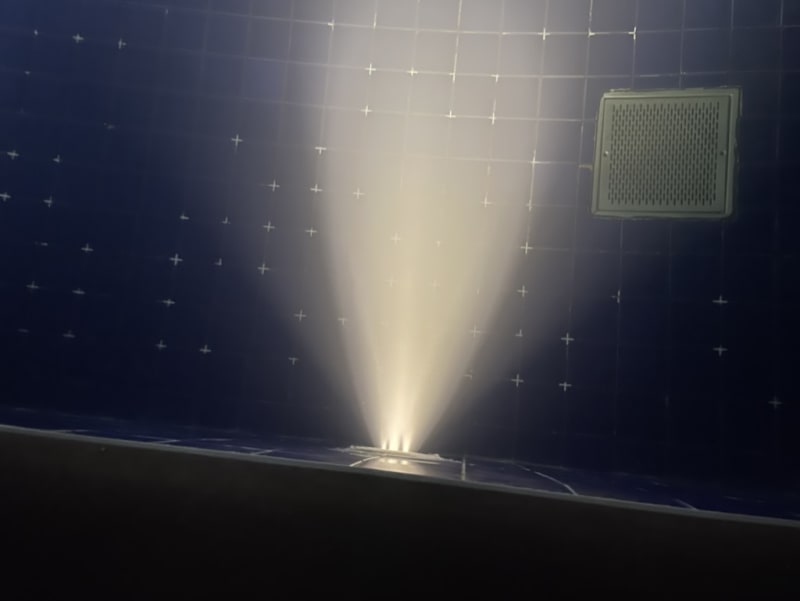
That is what people are describing when they say the water looks different. It is not a brighter blue or a better light. It is the absence of the fine suspended load that a sand bed was never able to hold — the dust you only see when a beam of light crosses the pool at night.
Our own commissioning standard is 10 microns — the band drinking water is typically filtered to, first achieved on an institutional competition pool and since held as the baseline on every project. Media is one of three things that gets you there. The other two are filter surface area and filtration velocity, and on an existing pool they are governed by the buried pipework between the pool and the plant room.
Changing the media is the simplest upgrade on this entire page — the vessel stays, the plumbing stays, the bed is swapped. Taking clarity all the way to the standard may need more than that, and the survey is what tells us which.
The sharp odour and the stinging eyes people associate with a pool are chloramines — what forms when chlorine meets sweat, sunscreen and body oils. A pool that smells strongly is telling you there is too little effective sanitiser in it, not too much. Hand dosing makes it worse, because it creates a peak every morning and a trough by evening.
Adding UV or ozone as a secondary barrier changes that. Both work inside the plant room, on water passing through them, and neither replaces chlorine — they let the pool run at a fraction of it, typically low enough that nobody in the water can smell or feel it. UV additionally deals with the chlorine-resistant parasite that normal residuals barely touch.
Of everything here, this is among the most straightforward to add. UV is close to fit-and-forget — an annual lamp and a sleeve to keep clean. Ozone asks more of the plant room, because it needs a proper chain of injector, contact tank and degasser rather than an injector clipped onto a pipe, and the space for that is a question the survey answers.
Most older pools were given general illumination and nothing else — two fittings in a wall, chosen to make night swimming possible rather than to make the pool worth looking at. Light is a layer, not a fitting, and the layers can be added.
Main LEDs replace the originals in their existing niches, usually in a day, in warm white, cool white or full colour. Step and bench markers make level changes read at night, which on a pool used by guests is a safety item as much as an aesthetic one. Strip lighting tracing the perimeter or the step edges is the layer that makes an ordinary rectangle read as architecture after dark.
A fibre optic star floor — points of light in the pool floor, with no electricity in the water at all — is the one layer that has to be built into the structure. On an upgrade that window is open exactly once: while the finish is off. Which is the single best argument for deciding the whole lighting scheme before the tiling is touched, rather than after.
The four layers of pool light →A pool of the older generation does nothing unless somebody is in it. The surface sits flat, the pump hums somewhere out of sight, and from the house the pool is a sheet of glass in the garden. A water feature — a blade dropping a clean ribbon of water, a curtain along a raised wall, a fall from a planter, deck jets arcing in — changes what the pool is doing the other twenty-three hours of the day. It moves, it catches light, and it is heard before it is seen.
The sound is half the point. Falling water is the one noise that makes other noise disappear, and on an urban plot a blade or curtain running in the evening does more for the sense of privacy than any wall. Sized gently it is a murmur under conversation; sized up it is the voice of the garden. Paired with the lighting layers above, it is also the single most photographed thing on a pool after dark.
On an existing pool these are added more easily than most owners expect, because a feature done properly never runs off the filtration circuit anyway — it gets its own pump and its own pipe run, sized to the exact sheet of water it has to produce. New construction hides that pipe in the shell; a retrofit routes it along walls and planters where the structure allows, which is why placement is agreed after the survey, not from a catalogue picture.
Two honest operating notes. Moving water evaporates faster than still water, and on a heated pool an all-day waterfall is an all-day heat leak — so features run on their own schedule, for the hours they earn. And falling water aerates: it drives off dissolved carbon dioxide and nudges pH upward, which is one more argument for the automated chemistry two cards below rather than a reason to go without the pleasure.
A pool of this era was built on the assumption that somebody would vacuum it by hand. A person on the deck with a hose and a head, most mornings, whether the family was using the pool that day or not. That was simply how pools were kept, and nobody thought about it twice.
Since 2020 a great many owners have thought about it. The pool and the deck are among the most private parts of a property, and clients increasingly want them treated that way — not as a serviced area that a succession of people pass through on a daily rota, particularly during the long stretches when the pool is not being used at all.
A robotic cleaner answers that directly. It is self-contained: it drives the floor, climbs the walls and scrubs the waterline on its own cycle, filters what it lifts through its own cartridge rather than through the main plant, and asks for a person only to lift it in and out. Because it does not run off the pool’s own suction, it adds no hydraulic load to a circuit that on an older pool rarely has any to spare.
The brushing matters as much as the vacuuming. Biofilm forms on walls and steps long before anybody notices the water, and no amount of chlorine removes it — it has to be physically scrubbed off. A machine that does that on a schedule is doing hygiene work, not housekeeping.
It is also the easiest item on this page to adopt: nothing is cast in, nothing is plumbed, and the plant room is not asked for a single additional square metre. What it does not do is replace water chemistry, filtration or a service visit — the plant room still needs a trained pair of hands on a fixed interval. It removes the daily presence, not the expertise.
The band a pool’s chemistry should sit in is narrow, and hand dosing visits that band twice a day rather than living in it — the morning peak and evening trough described under sanitisation above are simply what a once-a-day human looks like when a graph is drawn of them. Automation replaces the visits with residence: probes in the plant room read the water continuously, and dosing pumps add what is needed at the moment it is needed, in doses too small for anyone in the pool to ever notice.
Every other upgrade on this page is protected by this one. A heater, new glass media, a UV lamp, fresh grout and a new waterline are all either preserved or quietly eaten by the water they sit in, and the low, comfortable chlorine residual that UV makes possible is only safe to run when something is watching it around the clock. Steady water is not a luxury on top of the other upgrades; it is the condition they assume.
The controller also reports. The pool’s numbers, the dosing activity and any alarm are visible on a phone, from anywhere — which changes the question an owner can ask from “did someone check the pool?” to “what is the pool reading right now?” Together with the robotic cleaner above it completes the quieter arrangement many owners have wanted since 2020: a pool that is cleaned, dosed and watched without being attended daily.
The honest limit: automation holds a pool steady between visits; it does not end them. Probes drift and need calibration, some parameters are still verified by hand, and the plant room still wants a trained eye on a fixed interval. What changes is what that visit is — verification of a system that held, rather than rescue of water that drifted.
None of these were withheld from the original pool. They were simply not affordable, or not yet invented, on the day it was built.
We will not quote an upgrade from photographs. What can be done to an existing pool is decided by things that are invisible until someone goes and measures them.
Circulation flow measured rather than assumed, turnover period calculated against it, and the buried pipe sizes established. This single finding governs how far clarity can be taken.
Usable space, access, ventilation, drainage and electrical capacity. A heat pump, a spa jet pump and blower, a counter-current unit, a UV chamber and an ozone contact tank all need room and power the original plant room was never asked to provide.
A static water-loss test, isolating structure, plumbing and balancing tank in sequence. Heating a pool that leaks is the most expensive mistake available on an upgrade, and the loss is routinely written off as evaporation.
Suction outlets and covers, bonding and earthing of metalwork, RCD protection on every pool circuit, and the voltage actually running through the deck. Where these fail, they are corrected first and not traded against anything else in the scope.
Fill water tested for hardness and metals — both decide what new media and a new sanitiser will do on the day they are switched on — along with the condition of tiling, grout, coping and waterline.
A written report: what the pool is currently achieving, what each upgrade would require on this specific site, what is not feasible and why, and what it would cost to do properly. It is a standalone piece of work, and it is yours whether or not you go further with us.
Three things are decided when the shell is cast, and no amount of equipment added later undoes them. An honest proposal names these before it names a price.
Media can be changed and filters enlarged at any time. The pipes running under a finished deck and pool floor cannot, and they set the ceiling on flow for the whole system. Where that ceiling is low, we will say what clarity is actually reachable rather than sell filtration the pipework will not let work.
A below-grade pit reached through a manhole was difficult to maintain when it was new. Adding a heat pump, a spa pump, a UV chamber and a dosing system to it is not an upgrade — it is a maintenance problem compounded. Sometimes the correct recommendation is to relocate or extend the plant room first, and sometimes it is not to proceed at all.
A leak is a structural matter, not a treatment one, and it has to be isolated and repaired at source before anything else is specified. Nothing on this page compensates for it, and heating makes the cost of ignoring it considerably worse.
We have told clients that a pool should not be built. We will equally tell an owner that a pool should not be upgraded until something more fundamental is put right. The plant room argument → How a leak is actually found →
An operating pool is a different problem from an empty site. The whole plan is built around how long the water has to be out of use, and that number is agreed before anything is ordered.
On site, with the pool running and then with it isolated. Typically a day, plus the water-loss test which runs over several days on its own.
What is feasible, what it achieves in numbers, what it costs to build and what it costs to run. Each upgrade is priced separately so they can be taken in stages rather than all at once.
Nothing is drained until everything needed is on site. The commonest cause of a pool standing empty for months is a scope that began before the long-lead items were ordered.
Plant room work, structural repair and any finish work, run as one agreed shutdown rather than several. On a hospitality property this is scheduled against the season, not against our convenience.
Water commissioned to the clarity standard agreed in the proposal, chemistry brought into range, heating proved at temperature, jets and counter-current balanced, and the whole system handed over with documentation and operator training.
New equipment changes the maintenance routine — a lamp, a cover and a media bed all have service intervals the previous pool never had. Those intervals go into the handover document, not into a conversation two years later.
The six stages we build new pools to are unchanged — they simply start from a pool instead of a drawing. See the full process →
The land was the expensive decision, and it was made twenty years ago. Everything else is still open.
Already Have a Pool
Tell us the age of the pool, roughly its size, and what about it you would change. We will tell you honestly what can be done to it — and what cannot.