Tap anywhere outside image to close
Filtration, plant room discipline, and the engineering decisions that determine whether a pool stays genuinely clean — not just clear at a glance.
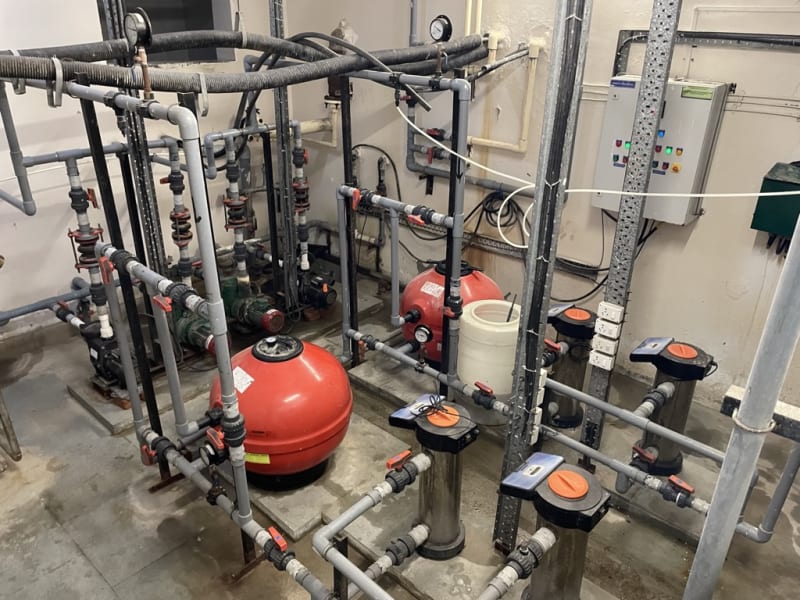
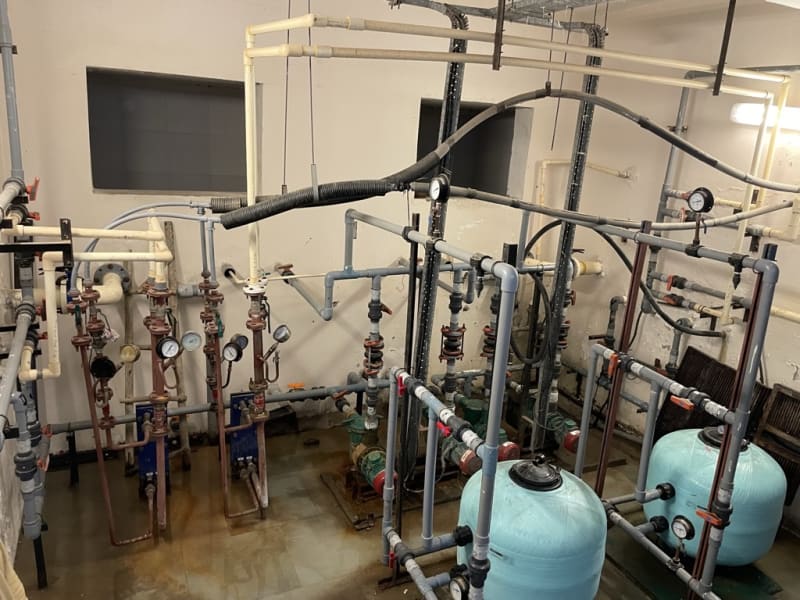
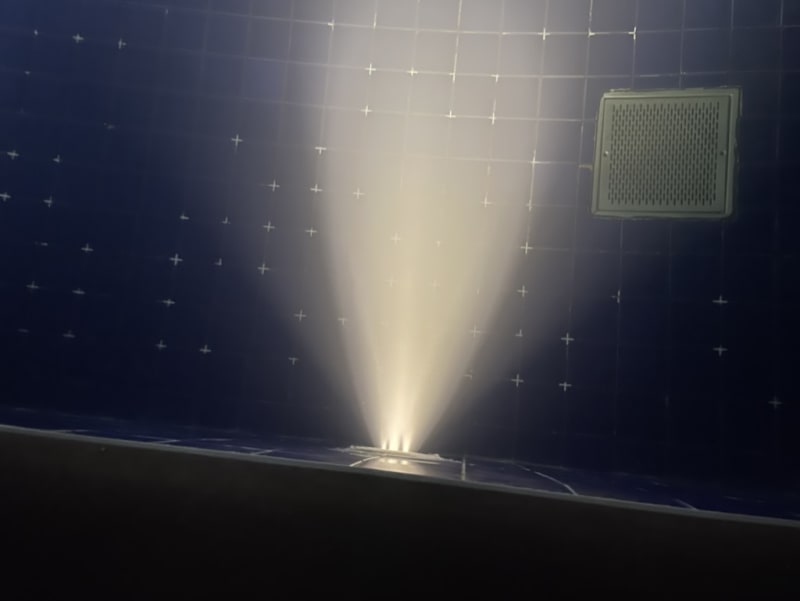
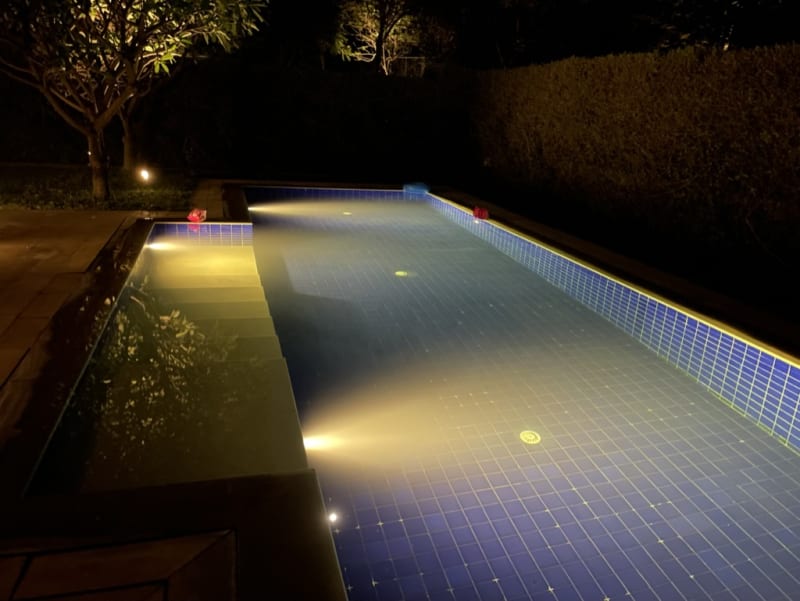
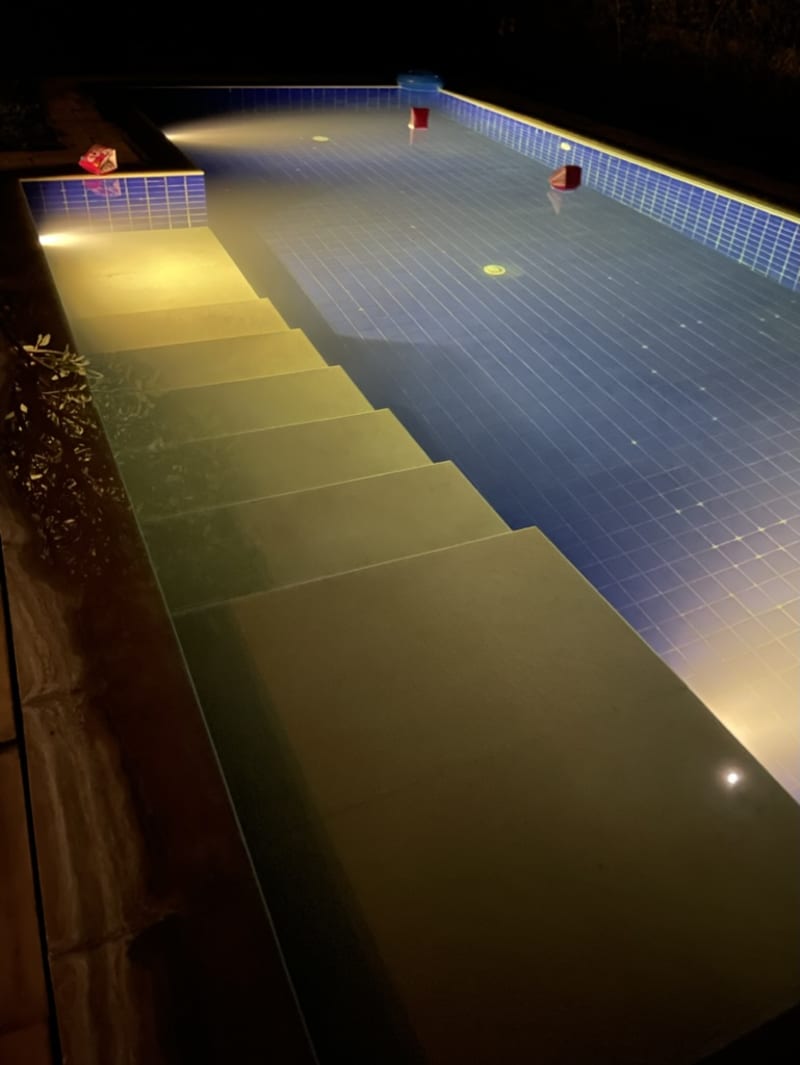
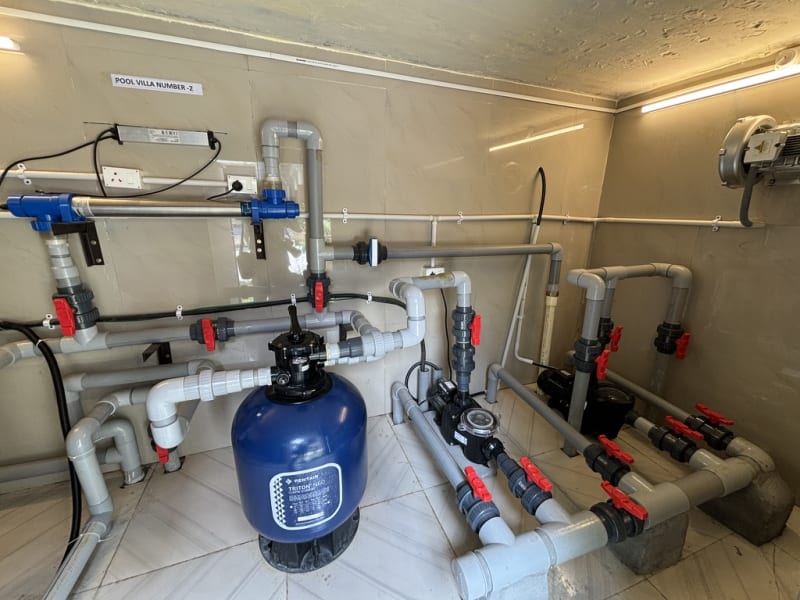
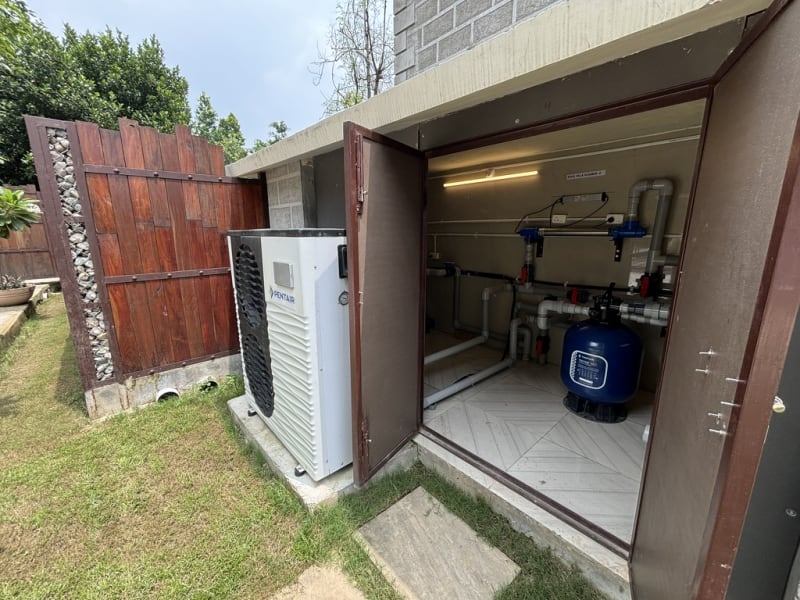
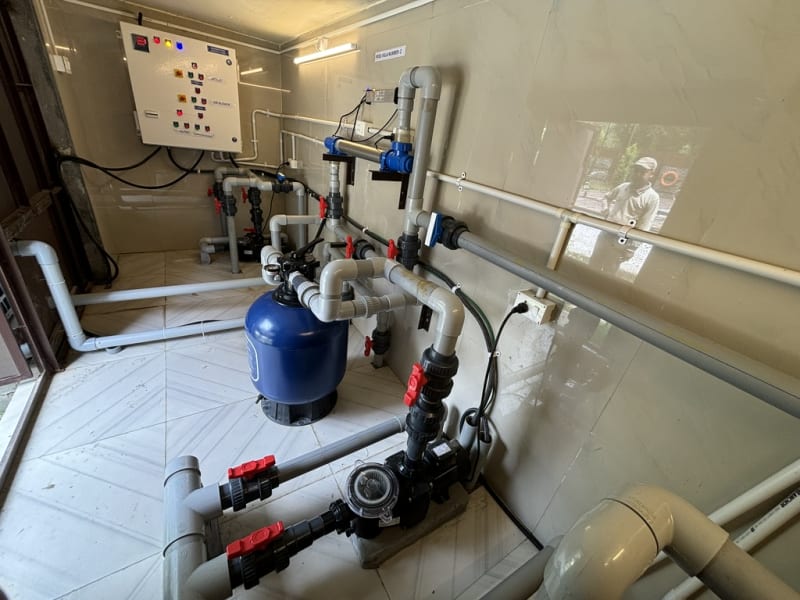
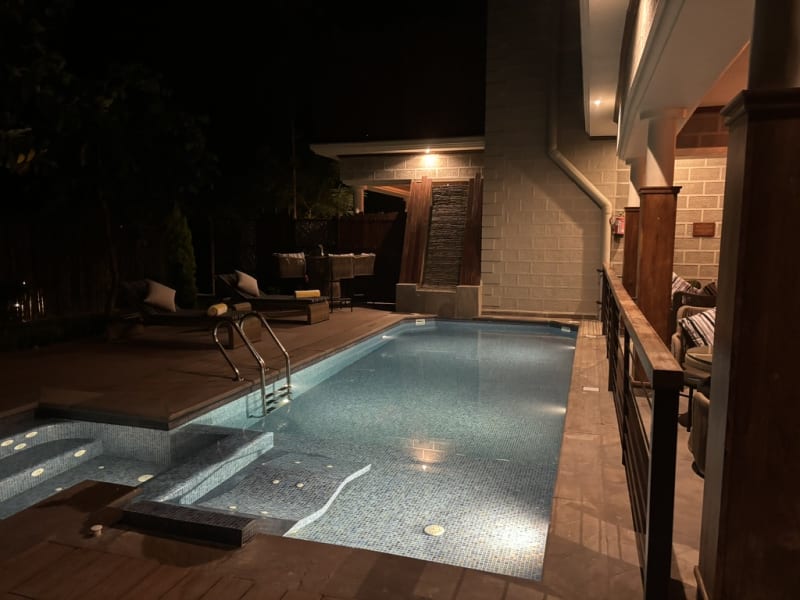
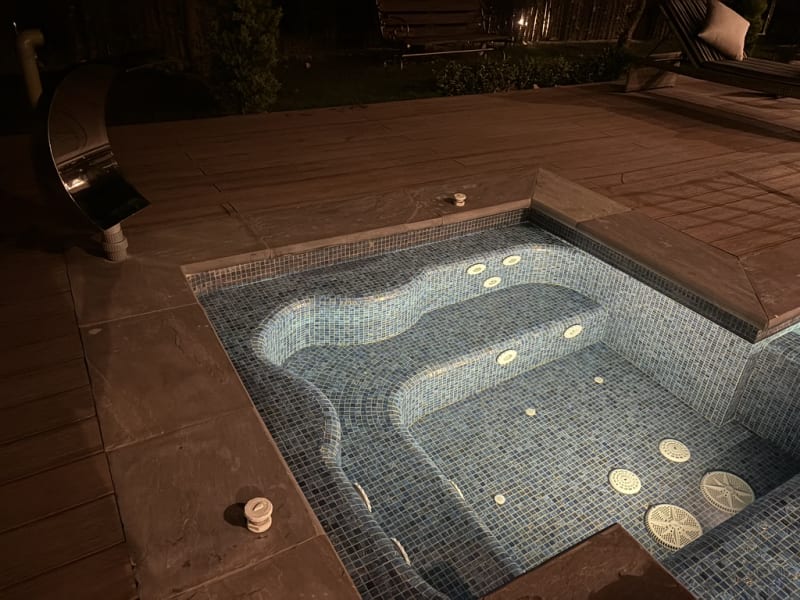
Two pools, photographed at night, both in five-star Indian hospitality properties. One shows 10-micron water clarity and a plant room built by people who understood what they were building. The other shows visible particulate in the water and plumbing assembled without the discipline the brand's own budget should have guaranteed.
Neither failure was about money — both properties could clearly afford the best. Somewhere between the budget and the finished pool, the expertise that should have been there wasn't. This is what happens when the most important part of a luxury property is treated as a commodity, not a specialism.
The Cause — Plant Room
The irony of pool hydraulics is that the system is only as good as its weakest link. Once the pipe selection is incorrect, even adding additional filtration to compensate doesn't help — it only makes the system look messier, without solving the underlying problem.
The Effect — Water Quality
Undersized filtration and excessive flow velocity prevent particulate from being captured — the dust and debris visible in light beams here are the direct result of the plant room above. This is the same system; the failure in one becomes visible in the other.
Every plant room we build follows the same principles regardless of scale — accessible isolation valves, labelled lines, and clearances that make servicing simple. 10-micron clarity follows naturally when filtration, flow velocity, and turnover are designed together, not assembled piecemeal. Read the full plant room philosophy →
The Cause — Plant Room
✓ Labelled, Accessible, Built to Last
The Effect — Water Quality
✓ 10-Micron Clarity, Verified
Most swimming pool filtration equipment sold in India is designed to European and North American standards. Typical recommended filtration rates of 35–45 m³/hr/m² are based on climates with significantly lower dust levels than those experienced across much of India.
Indian conditions are different. High temperatures accelerate biological growth, while seasonal dust storms dramatically increase the particulate load entering the pool. Under conventional international filtration rates, a pool affected by a dust storm can take up to 48 hours to regain full clarity — often just in time for the next storm. In the typical swimming season of May to July, when thunderstorms arrive roughly every second day, bathers are left with hardly any days to actually swim.
For this reason, Premium Pools designs filtration systems with flow velocities below 25 m³/hr/m², a standard developed specifically for Indian conditions rather than adopted from overseas practice.
The critical factor is not the filter alone. Flow velocity is governed by the narrowest point in the hydraulic system — most often the pipework. Filters can be upgraded at any time; undersized plumbing embedded beneath finished decks and pool bottom cannot. Hydraulic design must therefore be determined before construction begins.
| Conventional Imported Design | Premium Pools Design |
|---|---|
| Designed for European/North American conditions | Designed specifically for Indian conditions |
| 35–45 m³/hr/m² filtration velocity | Below 25 m³/hr/m² filtration velocity |
| Optimised for lower particulate loads | Optimised for India's dust and climate |
| Larger filters often specified | Entire hydraulic system engineered together |
| Filter can be upgraded later | Pipe sizing has to be correct from day one |
A common misconception in pool filtration is that increasing the number of filters automatically improves water quality. In reality, water clarity depends on filter surface area, media depth, and filtration velocity — not equipment count.
The chart below shows how particulate removal efficiency falls as filtration velocity increases, and how glass media outperforms silica sand at every velocity band. A shallower media bed reduces a filter’s ability to retain suspended particles, making reduced clarity a predictable outcome.
Particulate removal efficiency vs. filtration velocity — glass media vs. silica sand. Hover over the chart for exact readings.
Sand-curve shape and the 25 m/h threshold reflect PWTAG's published filtration rate guidance (low-rate ≤10 m/h, medium-rate 10–25 m/h, high-rate 25–50 m/h; high-rate ≈10–25% as effective as medium-rate). Source: pwtag.org. Glass-media curve reflects directional industry consensus on finer particle capture, not a single controlled study.
Cartridge filters typically capture particles down to 10–20 microns — finer than sand (20–40 microns), coarser than glass (3–10 microns). Shown as a single reference value, not a velocity curve: cartridge systems use a much larger surface area at a fundamentally different, lower flux rate than sand or glass beds, and PWTAG does not publish an efficiency-vs-velocity relationship for them.
Clear water is achieved by engineering, not by installing more equipment.